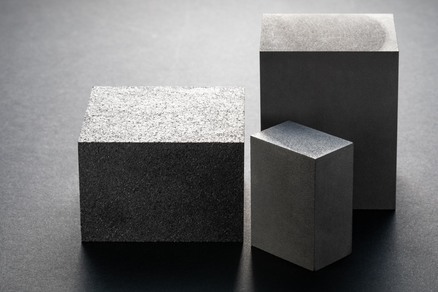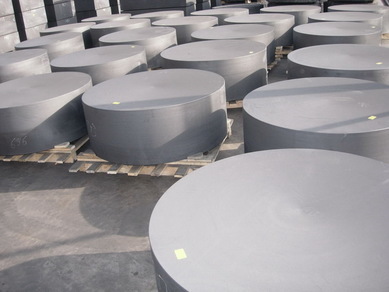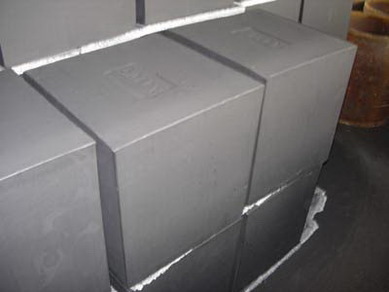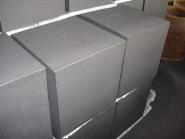
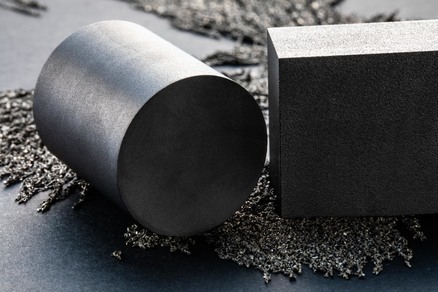
The unique properties of specialty graphite, such as excellent resistance to super high temperature, thermal shock and chemical corrosion and high thermal conductivity, make it be one indispensable industrial material.
Our Product Grades: PFR, PFRN, ISO Applicable Industries:
·Mechanical casting / Foundry
·Battery industry
·Energy sector
·Aerospace
·Semiconductor industry
for more products detail
Specialty Graphite Products
PFR
PFR grade product is made by vibration molding, with a maximum particle size of 0.8 mm. It exhibits good micro-structural consistency, stable and reliable performance.
Specific applications include:
· Graphite crucibles
·Heating elements for high-temperature furnaces
·Structural components for high-temperature furnaces
·Powder metallurgy molds
Property
Typical Value
Unit
Bulk Density
1.73
g/cm3
Electrical Resistivity
8
μΩm
Thermal Expansion (600℃)
3.6
10-6/℃
Compressive Strength
32
MPa
Flexural Strength
14
MPa
Specialty Graphite Products
PFRN
In comparison with PFR, PFRN exhibits superior bulk density and mechanical strength, resulting in enhanced durability.
applications include:
·Precision casting molds
·Graphite parts for aluminum refining
·Powder metallurgy
Property
Typical Value
Unit
Bulk Density
1.75
g/cm3
Electrical Resistivity
8
μΩm
Thermal Expansion (600℃)
4
10-6/℃
Compressive Strength
35
MPa
Flexural Strength
20
MPa
Ash Content
0.1
μm
Thermal Conductivity
135
W/m·K
Specialty Graphite Products
ISO
Isostatic graphite refers to graphite materials produced by the isostatic pressing method. Within the family of specialty graphite materials, isostatic graphite has become an important material in high?temperature and high?precision industrial applications, owing to its unique forming process and uniform physical properties. Its main characteristics include strong thermal shock resistance, high?temperature resistance, large forming dimensions, and a homogeneous internal structure.
Application fields include:
·Aerospace
·Continuous casting of metals
·Photovoltaic
·Semiconductor
· Anode materials (for batteries)
·EDM (Electrical Discharge Machining)
Property
Value
Unit
Bulk Density
1.75-1.85
g/cm3
Electrical Resistivity
10~13
μΩm
Thermal Conductivity
115
W/m·k
Thermal Expansion (600℃)
5
10-6/℃
Shore Hardness
60
HSD
Compressive Strength
110
MPa
Flexural Strength
50
MPa
Ash Content
100
ppm
Specialty Graphite Products
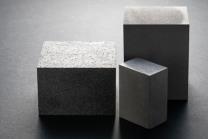
The unique properties of specialty graphite, such as excellent resistance to super high temperature, thermal shock and chemical corrosion and high thermal conductivity, make it be one indispensable industrial material.
Our Product Grades: PFR, PFRN, ISO Applicable Industries:
·Mechanical casting / Foundry
·Battery industry
·Energy sector
·Aerospace
·Semiconductor industry
for more products detail
Specialty Graphite Products
PFR
PFR grade product is made by vibration molding, with a maximum particle size of 0.8 mm. It exhibits good micro-structural consistency, stable and reliable performance.
Specific applications include:
· Graphite crucibles
·Heating elements for high-temperature furnaces
·Structural components for high-temperature furnaces
·Powder metallurgy molds
Property
Typical Value
Unit
Bulk Density
1.73
g/cm3
Electrical Resistivity
8
μΩm
Thermal Expansion (600℃)
3.6
10-6/℃
Compressive Strength
32
MPa
Flexural Strength
14
MPa
Specialty Graphite Products
PFRN
In comparison with PFR, PFRN exhibits superior bulk density and mechanical strength, resulting in enhanced durability.
applications include:
·Precision casting molds
·Graphite parts for aluminum refining
·Powder metallurgy
Property
Typical Value
Unit
Bulk Density
1.75
g/cm3
Electrical Resistivity
8
μΩm
Thermal Expansion (600℃)
4
10-6/℃
Compressive Strength
35
MPa
Flexural Strength
20
MPa
Ash Content
0.1
μm
Thermal Conductivity
135
W/m·K
Specialty Graphite Products
ISO
Isostatic graphite refers to graphite materials produced by the isostatic pressing method. Within the family of specialty graphite materials, isostatic graphite has become an important material in high?temperature and high?precision industrial applications, owing to its unique forming process and uniform physical properties. Its main characteristics include strong thermal shock resistance, high?temperature resistance, large forming dimensions, and a homogeneous internal structure.